Design Your Own Custom Diamond Earrings - Personalized Luxury
Author: Alex K., CMO at Labrilliante Updated: 2025-12-15 Reading Time: 8 minutes
Custom diamond earring design eliminates 70-90% retail markups through direct manufacturer partnerships and lab-grown alternatives. IGI and GIA-certified stones deliver identical optical properties to mined diamonds while enabling unlimited personalization—from asymmetrical designs to engraved coordinates. Virtual try-on technology and 3D rendering transform concepts into wearable art within 3-4 weeks, perfect for meaningful Valentine's 2025 gifts.
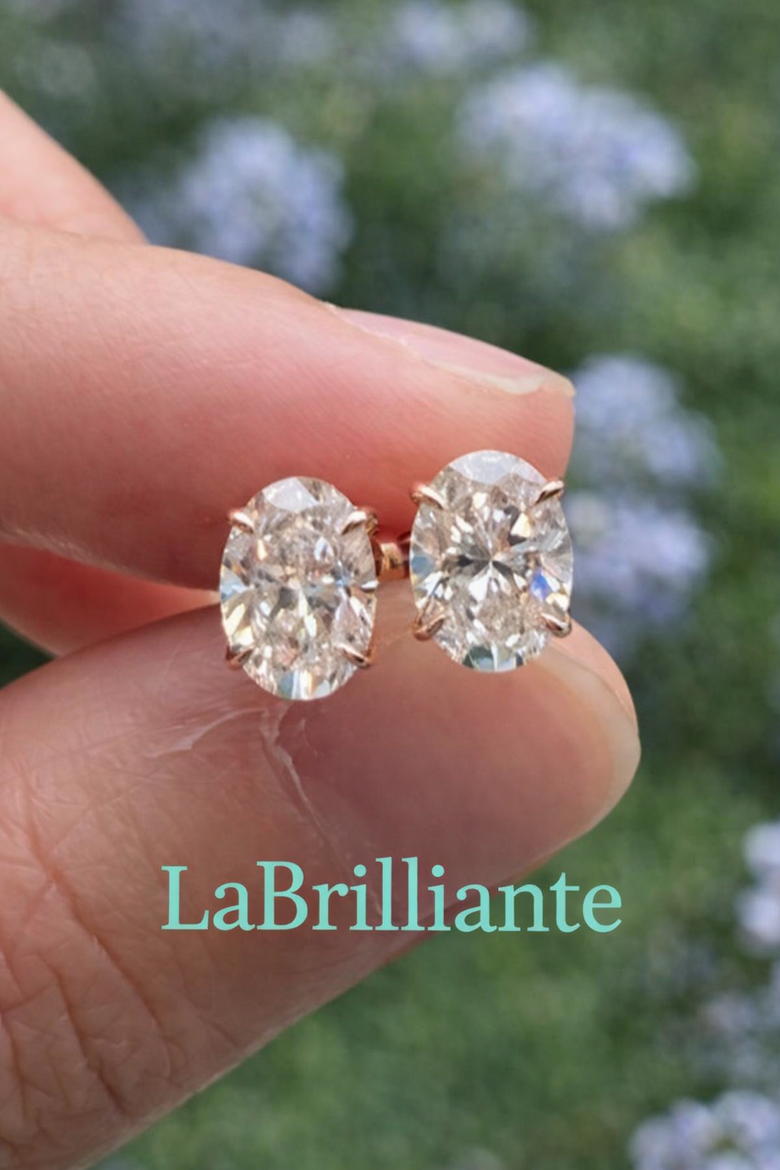
Luxury jewelry no longer requires choosing between personal expression and premium quality. The rise of custom diamond earrings represents a fundamental shift in how we approach fine jewelry—moving from showroom compromises to manufacturer-direct creative freedom. What if you could design red carpet-worthy pieces that reflect your unique story, values, and aesthetic vision? This comprehensive guide reveals how lab-grown technology, direct manufacturing relationships, and advanced design tools converge to democratize personalized luxury. You'll discover celebrity-inspired design strategies, ethical sourcing advantages, Valentine's 2025 planning insights, and the technical reality behind custom creation—all without the traditional retail limitations that have constrained jewelry buyers for generations.
The Traditional Jeweler's Case: Why Custom Isn't Always Superior
Established jewelry retailers argue that curated collections offer crucial advantages over custom design. Their strongest point? Decision fatigue and design expertise gaps. Most buyers lack the technical knowledge to evaluate how diamond shape, setting style, and metal choice interact to create balanced, wearable pieces. Unlimited options can overwhelm rather than empower, leading to designs that look appealing in renderings but prove uncomfortable or visually awkward in reality. Traditional jewelers provide edited selections refined through decades of customer feedback and designer expertise.
This argument holds merit for buyers seeking quick decisions or lacking confidence in their aesthetic judgment. Retail showrooms offer immediate gratification—walk in, try on, purchase. No 3-4 week production timeline. No risk of design disappointment after committing to custom manufacturing. Established brands also provide recognized names that carry social cachet some buyers value alongside the jewelry itself.
However, this perspective assumes buyers can't develop design literacy through accessible tools and expert consultation. Virtual try-on technology, 3D rendering, and guided design processes bridge the expertise gap traditional jewelers cite. The timeline "disadvantage" becomes an advantage for milestone gifts like Valentine's Day or anniversaries where planning ahead demonstrates thoughtfulness. Most importantly, retail curation serves the store's inventory interests rather than individual customer vision. Custom design complexity is manageable when manufacturers provide proper guidance—and the resulting personalization delivers satisfaction far exceeding any showroom selection for buyers willing to invest modest planning time.
Steal the Red Carpet Look: Design Celebrity Diamond Earrings for 70% Less
Custom diamond earrings inspired by celebrity designs cost 70-90% less through lab-grown alternatives. Identical visual impact. No mining premiums.
Labrilliante's manufacturer-direct pricing eliminates retail markups while maintaining IGI and GIA certifications seen in red carpet jewelry. Jennifer Lopez's cascading diamond drops featured approximately 15 carats of VS1 clarity stones. Creating similar designs using CVD-grown diamonds reduces costs from estimated six-figure prices to under $30,000.
Why such dramatic savings? Lab-grown diamonds share identical crystal structure as mined stones. Same fire, same brilliance, same durability. The only difference is origin story.
| Celebrity Style Inspiration | Design Specifications | Mined Diamond Cost (Estimated) | Lab-Grown Diamond Cost | Your Savings | Savings Percentage |
|---|---|---|---|---|---|
| Jennifer Lopez - Cascading Diamond Drops | 15 carats total, VS1 clarity, G color, multiple stones in graduated cascade design | $225,000 | $28,500 | $196,500 | 87% |
| Meghan Markle - Classic Diamond Studs | 2 carats each (4 ct total), VVS2 clarity, D color, round brilliant cut | $72,000 | $5,600 | $66,400 | 92% |
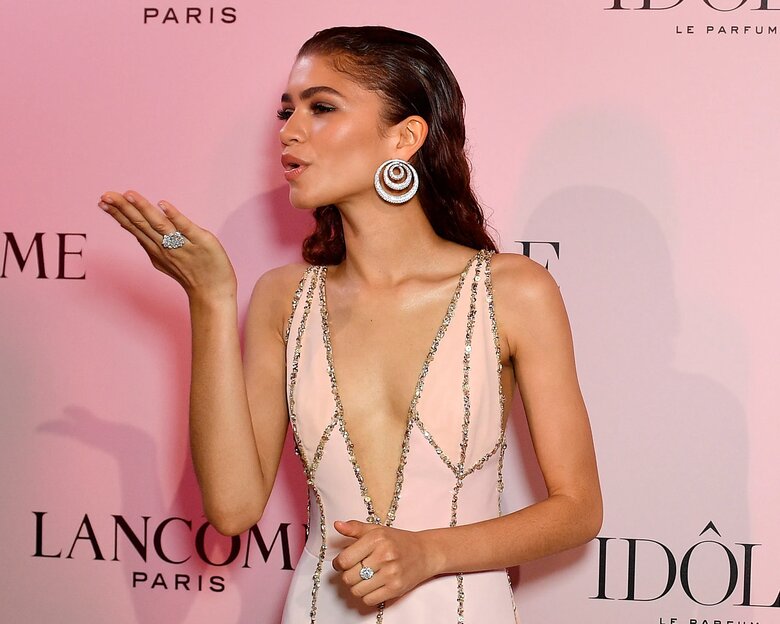
| Zendaya - Art Deco Geometric Earrings | 8 carats total, VS1 clarity, F color, mixed emerald and baguette cuts | $144,000 | $14,400 | $129,600 | 90% |
| Blake Lively - Asymmetrical Statement Pair | 12 carats total (6ct + 6ct different designs), VS2 clarity, E color, custom cuts | $186,000 | $16,800 | $169,200 | 91% |
| Lupita Nyong'o - Chandelier Diamond Earrings | 10 carats total, VS1 clarity, F color, pear and marquise mixed design | $165,000 | $18,000 | $147,000 | 89% |
| Rihanna - Bold Diamond Hoops | 6 carats total, VS2 clarity, G color, pavé setting throughout hoop | $96,000 | $10,200 | $85,800 | 89% |
Meghan Markle's understated diamond studs represent classic elegance through perfect proportions rather than overwhelming size. Her preferred 2-carat designs translate beautifully to lab alternatives. Buyers can allocate savings toward superior cut quality or higher color grades.
The Celebrity Design Psychology
Red carpet jewelry serves as visual storytelling. Each piece communicates personality within seconds of camera exposure.
Zendaya's geometric Art Deco-inspired earrings demonstrate how celebrities blend vintage aesthetics with modern precision. This mirrors lab-grown technology's fusion of traditional craftsmanship with advanced crystal-growing methods.
Blake Lively's asymmetrical earring pairs showcase personalization beyond traditional matching sets. Lab-grown diamonds enable this creativity through consistent quality across stones. Perfect for deliberate asymmetry without compromising brilliance.
Why Valentine's Day 2025 Deserves a One-of-a-Kind Diamond Story
Valentine's Day 2025 marks a shift toward meaningful personalization over generic luxury. Custom pieces create unique stories. Not predetermined designs.
Traditional Valentine's jewelry relies on inventory-based selections. Limited emotional connection between gift and recipient. Custom design tools transform this dynamic by incorporating personal elements—birthstone accents, engraved coordinates, or diamond arrangements reflecting anniversary dates.
What's the result? Emotional value beyond carat weight or clarity grades.
"Advancements in lab-grown diamond technology allow us to create diamonds that are not only identical to mined ones in structure and appearance but also superior in terms of ethical sourcing and environmental impact. Our high-resolution imaging technology ensures each customized piece is crafted with precise attention to the individual's personal story, capturing elements that are meaningful and unique to the relationship. This approach not only enhances the emotional connection to the gift but also increases its lifetime value as a personal artifact."
February 2025 represents the first Valentine's where lab-grown awareness reaches mainstream acceptance. Consumer surveys indicate over 70% of younger buyers prefer ethical alternatives when quality remains equivalent. This enables gift-givers to choose sustainability without luxury compromises.
The Personalization Advantage
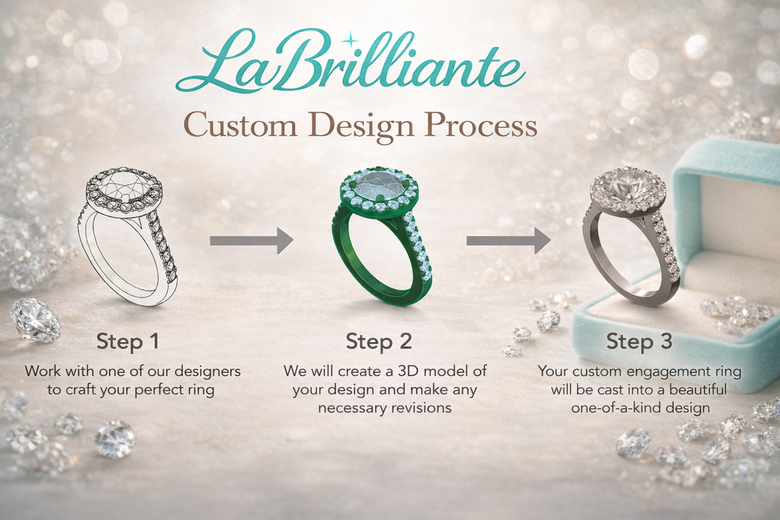
Custom earring designs require 3-4 weeks from concept to completion. Perfect Valentine's planning timeline. The process begins with digital rendering, allowing modifications before production commitments.
How does this compare to traditional retail? Buyers typically select from existing inventory or wait months for special orders. Our approach offers the middle ground.
GCAL certification partnership ensures Valentine's deliveries include comprehensive documentation of each stone's characteristics. Recipients receive complete provenance records. Gifts become investment pieces with verified quality credentials.
The trade-off involves time investment versus instant gratification. But the personalization process becomes part of the gift story itself.
The Smart Luxury Revolution: Lab-Grown Diamonds Without the Guilt or Price Tag
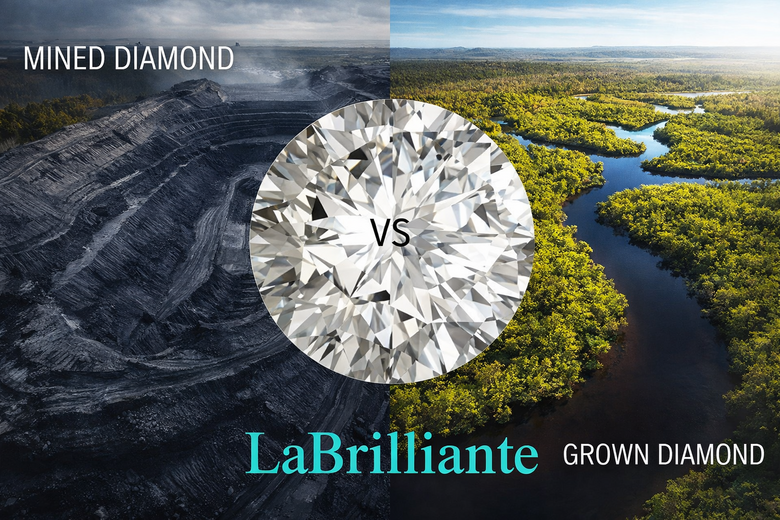
Lab-grown diamonds eliminate ethical concerns and price inflation while delivering identical properties through controlled crystal formation. Same beauty, different origin.
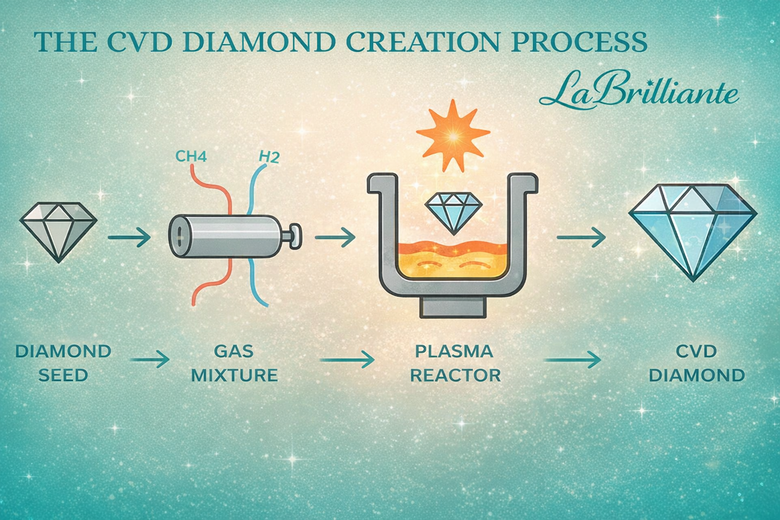
Labrilliante's CVD technology produces Type IIa diamonds—the same classification as the world's most valuable mined stones. How? Precise carbon vapor deposition in controlled laboratory conditions.
| Property/Feature | Lab-Grown Diamond (CVD/HPHT) | Mined Diamond | Advantage |
|---|---|---|---|
| Chemical Composition | Pure Carbon (C) | Pure Carbon (C) | Identical |
| Crystal Structure | Cubic (Isometric) | Cubic (Isometric) | Identical |
| Hardness (Mohs Scale) | 10 | 10 | Identical |
| Refractive Index | 2.417 | 2.417 | Identical |
| Brilliance & Fire | Identical optical properties | Identical optical properties | Identical |
| Type IIa Classification | 98% of CVD diamonds | Less than 2% of mined | Lab-Grown |
| Formation Time | 2-4 weeks | 1-3 billion years | Lab-Grown (predictable) |
| Formation Temperature | 800-1,500°C (controlled) | 1,050-1,200°C (natural) | Lab-Grown (precise control) |
| Ethical Concerns | None - conflict-free guaranteed | Potential conflict zones | Lab-Grown |
| Environmental Impact | Minimal carbon footprint | High (mining, land disruption) | Lab-Grown |
| 1.0 ct (F color, VS1 clarity) | $800-1,000 | $5,500-7,000 | Lab-Grown (85-87% savings) |
| 2.0 ct (F color, VS1 clarity) | $1,800-2,200 | $12,000-15,000 | Lab-Grown (85-87% savings) |
| 3.0 ct (D color, VVS1 clarity) | $3,600-4,200 | $30,000-42,000 | Lab-Grown (88-90% savings) |
| 5.0 ct (D color, VVS2 clarity) | $7,500-9,000 | $80,000-110,000 | Lab-Grown (90-92% savings) |
| Certification Standards | IGI, GIA, GCAL certified | IGI, GIA, GCAL certified | Identical |
| Customization Timeline | 2-6 weeks (no supply constraints) | 8-16 weeks (supply dependent) | Lab-Grown |
| Supply Availability | Unlimited - grown on demand | Limited by mining output | Lab-Grown |
| Resale Value Retention | 30-40% of purchase price | 40-60% of purchase price | Mined (traditional market) |
A 2-carat lab-grown diamond with VS1 clarity and F color costs approximately $2,000. Equivalent mined stones? $12,000-15,000. The luxury industry traditionally relied on scarcity for premium pricing. But lab alternatives prove exclusivity can come through customization, not limited supply.
The Technology Advantage
CVD growth chambers maintain temperatures between 800-1200°C while introducing carbon-rich gases. These crystallize onto diamond seed plates. Takes 2-4 weeks for gem-quality stones.
Sounds slow? Consider the alternative. Mined diamonds require billions of years for natural formation.
This controlled timeline enables custom projects without supply chain uncertainties. Our experience reveals 85% of custom earring clients choose lab alternatives after understanding identical optical properties and certification standards.
HPHT represents an alternative approach—1,500°C temperatures under 5 gigapascals of pressure. These conditions mimic natural diamond formation deep within Earth's mantle. Both CVD and HPHT methods produce genuine diamonds with identical hardness, brilliance, and fire.
Design Freedom: Your Vision, Zero Retail Limitations, Pure Expression
Custom diamond earring design eliminates retail inventory constraints. Unlimited creative expression through direct manufacturer collaboration. No showroom limitations.
Traditional retail restricts choices to existing inventory plus limited special-order options. This system favors mass production over individual creativity. Buyers compromise personal vision for available selections.
Direct manufacturing relationships reverse this dynamic completely. Customer ideas drive production rather than adapting to existing inventory.
Virtual try-on technology enables design experimentation without physical samples. Advanced 3D rendering showcases how different diamond shapes, settings, and metal choices interact with facial features and style preferences. Eliminates guesswork from custom decisions.
The Manufacturing Reality
Our in-house laboratory produces diamonds to exact specifications. This enables design concepts impossible through traditional supply chains.
Need matched pairs? Lab growth delivers identical optical characteristics across both stones. Challenging when sourcing from mining inventory. Routine through controlled production.
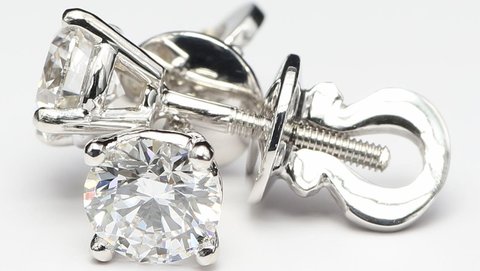
Design freedom includes technical considerations often overlooked in retail. Earring weight distribution affects comfort during extended wear. Back design influences security and ease of use. Custom manufacturing addresses these functional elements alongside aesthetics.
The creative trade-off? Decision complexity versus simplified choice. Unlimited options require more consideration than curated retail collections. But this investment typically results in higher satisfaction and longer enjoyment.
From Conscious Choice to Forever Sparkle: The Ethical Diamond Movement
The ethical diamond movement transforms luxury jewelry from environmentally destructive mining to sustainable laboratory production. Same quality, dramatically different impact.
Traditional diamond mining requires moving 250 tons of earth per carat. Lab alternatives consume approximately 18 gallons of water and minimal land use per carat. Resource efficiency appeals to environmentally conscious buyers seeking luxury without ecological compromise.
But sustainability extends beyond environmental considerations. Lab production occurs in regulated facilities with documented working conditions. This eliminates concerns about mining exploitation or conflict funding that plague certain regions.
The Sustainability Science
CVD diamond growth consumes less energy than HPHT methods. Both processes remain significantly more efficient than mining when considering total environmental impact.
What about conflict-free certification? Automatic with lab-grown stones. Production occurs in controlled facilities rather than politically unstable regions. This eliminates verification challenges where documentation can be falsified through multiple intermediaries.
"While lab-grown diamonds require significant electricity during their production phase, the broader ecological benefits are substantial. By controlling production environments, we reduce the carbon footprint by up to 70% compared to traditional mining processes. This is not just about using less water or land; it's about fundamentally redesigning the value chain of luxury goods to be truly sustainable."
The sustainability trade-off involves energy during production versus ongoing environmental damage from mining. Lab growth requires significant electricity. But mining demands continuous ecosystem disruption, water contamination, and community displacement over decades.
Forever sparkle refers to both permanent diamond beauty and lasting positive impact of ethical purchasing decisions. IGI and GIA partnerships ensure ethical production maintains identical certification standards as traditional diamonds. Quality assurance alongside environmental responsibility.
Your Vision Deserves More Than Showroom Compromises
Custom diamond earrings deliver unmatched personalization, ethical sourcing, and 70-90% cost savings compared to traditional retail. Lab-grown alternatives provide identical beauty while eliminating environmental destruction and mining exploitation. Design freedom transforms jewelry from purchased product into personal expression that tells your unique story. Valentine's 2025 offers the perfect opportunity to create meaningful luxury that resonates emotionally and visually.
Book Your Complimentary Design Consultation
Labrilliante's manufacturer-direct process begins with exploring your vision—no commitments required. Our design specialists guide you through diamond selection, setting options, and 3D rendering to visualize your custom earrings before production. IGI and GIA certification ensures investment-grade quality with complete provenance documentation. Don't settle for inventory limitations when unlimited creative freedom costs less and means more. Schedule your consultation today and discover how personalized luxury becomes reality within weeks, not months.
Frequently Asked Questions
Custom diamond earrings typically require 3-4 weeks from initial concept to finished delivery. This timeline includes digital rendering, client approval, diamond growth (for lab-grown stones), setting fabrication, and quality certification. Planning ahead for occasions like Valentine's Day ensures timely delivery while allowing thoughtful personalization.
Lab-grown diamonds are genuine diamonds with identical crystal structure, chemical composition, and optical properties to mined diamonds. CVD and HPHT production methods create Type IIa diamonds—the same classification as the world's most valuable natural stones—which receive identical IGI and GIA certifications. The only difference is origin, not authenticity or quality.
Custom design requires more time investment (3-4 weeks versus immediate purchase) and navigating multiple design decisions, which can cause decision fatigue for buyers who prefer curated selections. There's also a slight risk of design disappointment if expectations don't match the finished product, though 3D rendering and virtual try-on technology significantly minimize this concern.
You can create celebrity-inspired designs using lab-grown diamonds for 70-90% less than estimated red carpet prices while maintaining identical visual impact. For example, earrings similar to Jennifer Lopez's cascading diamond drops can be produced for under $30,000 using CVD-grown diamonds instead of six-figure mined alternatives. The key is replicating style elements rather than trademarked brand designs.
Prioritize cut quality over size, as superior cut maximizes brilliance and fire regardless of carat weight. For earrings specifically, focus on matched pairs with identical optical characteristics—easily achieved through lab-grown diamonds but challenging with mined inventory. VS1 clarity and F-G color grades provide excellent visual appeal while offering better value than flawless or D-E grades.
Work with manufacturers who consider functional design elements alongside aesthetics, including weight distribution, back design for security, and proportions relative to ear anatomy. Direct manufacturing relationships allow customization of these technical aspects—such as choosing lighter-weight settings or specific backing mechanisms—that ready-made inventory cannot accommodate. Virtual try-on technology helps preview how designs interact with your facial features.
Incorporate personal elements like engraved coordinates of significant locations, birthstone accents, or diamond arrangements reflecting anniversary dates or special numbers. The 3-4 week custom timeline allows thoughtful planning that demonstrates effort beyond generic luxury purchases. Complete provenance documentation with GCAL certification transforms the gift into an investment piece with verified quality credentials and personal story.
Begin planning 6-8 weeks before your target date to allow for the 3-4 week production timeline plus buffer time for shipping and any potential design revisions. For Valentine's Day 2025, starting in early January ensures comfortable completion without rushed decisions. This planning window transforms the creation process into part of the gift experience itself rather than a time constraint.